
Every Frontier AI Lab Will Become a Cybersecurity Company
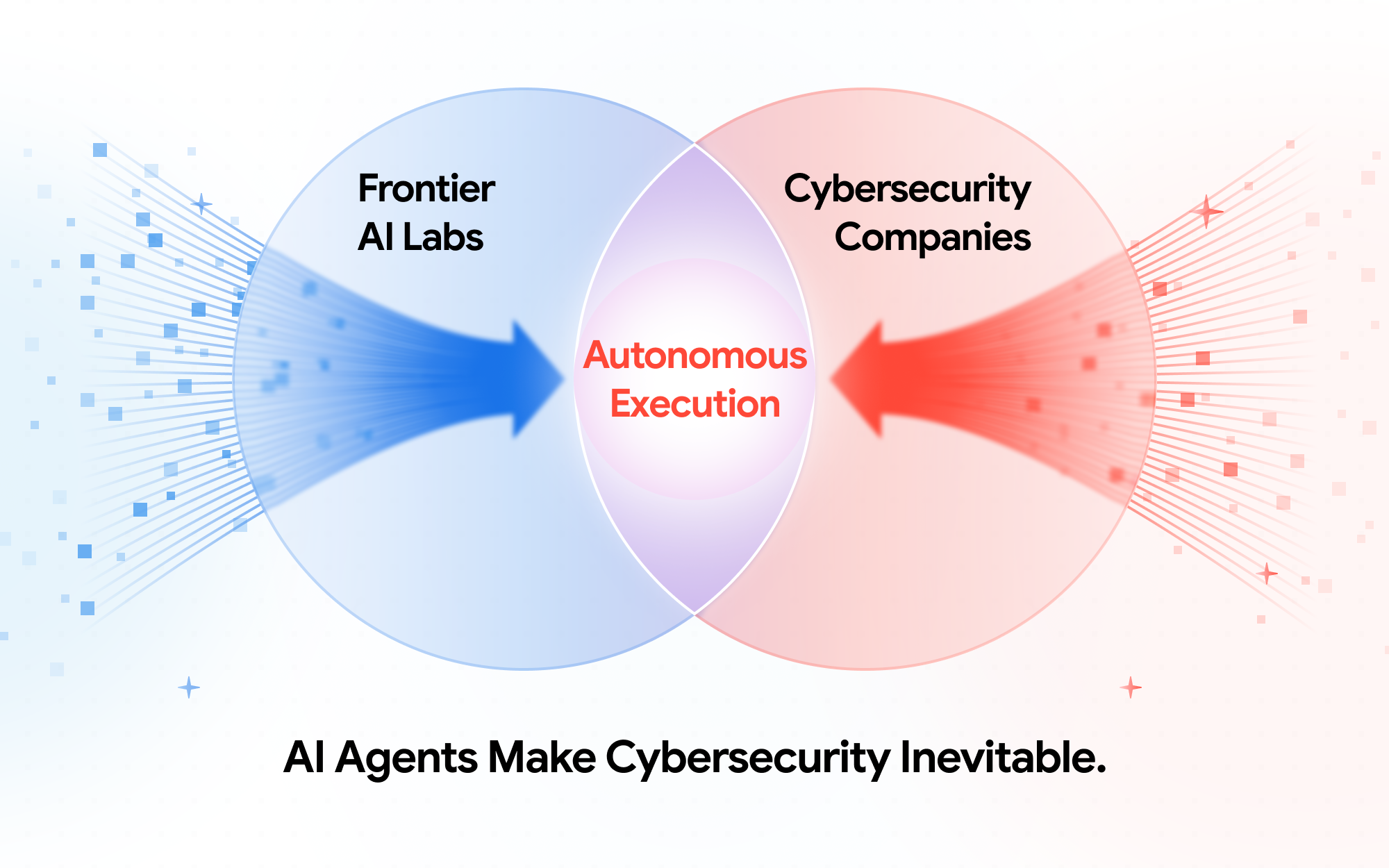
Frontier AI labs will become cybersecurity companies.
Autonomous execution is making cybersecurity intrinsic to frontier AI and creating a new requirement: Execution History.
By cybersecurity, I mean the capabilities and controls used to prevent, detect, investigate, constrain, and remediate harmful or unauthorized behavior in software and digital systems.
By cybersecurity company, I do not mean that every frontier AI lab will become a traditional security vendor. I mean cybersecurity becomes part of its core technology, operating model, and customer-facing products rather than merely an internal security function.
Two forces make this inevitable.
Capability pulls frontier AI labs into cybersecurity.
Autonomy prevents them from remaining outside it.
Frontier models understand code, reason across systems, operate tools, discover vulnerabilities, reproduce exploits, investigate incidents, and generate remediation. Those capabilities substantially overlap with advanced software engineering.
At the same time, those models are becoming agents. They receive credentials, invoke tools, access networks, modify code, interact with infrastructure, delegate tasks, and change external systems.
That creates a second consequence.
Once software acts, security must account for its execution.
It must distinguish what was authorized, requested, attempted, and performed; what results were observed; what state transition the evidence supports; which actors participated; and what evidence supports each claim.
This is the architectural consequence of autonomy.
And we can already see both sides of the transition.
OpenAI is building Codex Security and Daybreak, operating Patch the Planet with Trail of Bits, and is reportedly in early discussions to acquire Trail of Bits.[1][2][3][4]
Anthropic demonstrated advanced vulnerability discovery and exploitation through Project Glasswing, expanded that work into its Cyber Verification Program, and established the Anthropic Cyber Mission.[5][6][7]
Google combines Gemini, Mandiant, Wiz, Google Security Operations, agent identity, and agentic defense.[8]
Microsoft is deploying security agents while building dedicated identity, permission, and audit infrastructure for autonomous systems.[9]
These are not isolated product moves.
They are evidence of an industry transition.
1. Why AI Labs Become Cybersecurity Companies
The connection begins with software engineering.
The capabilities required to understand large codebases, debug failures, reason across components, operate terminals, and modify software substantially overlap with those required for vulnerability research.
Coding ability and cyber capability are not identical. But they share the same technical substrate.
OpenAI's GPT-5.3-Codex became the first OpenAI model the company is treating as High capability in cybersecurity under its Preparedness Framework. OpenAI explicitly says it does not have definitive evidence that the model reaches the High threshold, but is applying the corresponding safeguards because it cannot rule out that level of capability.[10]
Anthropic has observed the same progression. Its work with Claude has demonstrated advanced vulnerability discovery and exploitation, and Anthropic has explicitly connected cybersecurity strength to broader coding capability.[5]
Frontier systems change the scale of the problem: software inspection becomes continuous, investigations run in parallel, and systems reproduce failures, test hypotheses, analyze attack paths, and generate candidate remediations.
The same underlying capabilities support defense and offense.
Cyber capability therefore emerges from frontier-model development as both a product capability and a risk.
Autonomy adds the second force.
A conventional chatbot primarily returns information.
An autonomous agent performs operations against external systems. It interacts with repositories, terminals, browsers, cloud infrastructure, databases, APIs, CI/CD systems, enterprise applications, credentials, communication systems, and other agents.
The security problem therefore expands from:
What can the model do?
to:
What may the agent do, and what did it do?
OpenAI describes controls governing what coding agents access, when approval is required, which systems they interact with, and what telemetry organizations retain about agent activity.[11]
Microsoft is creating dedicated agent identities and agent-specific audit and sign-in records that distinguish agent activity.[9]
The progression is clear:
model -> agent -> identity -> authority -> tools -> actions -> results -> state changes
This is why frontier AI labs cross the boundary from companies that merely require cybersecurity to cybersecurity companies.
Cybersecurity becomes a model capability, an operational requirement, a deployment requirement, a dual-use problem, and a customer-facing product surface.
Capability pulls frontier AI labs into cybersecurity.
Autonomy makes cybersecurity inevitable.
2. AI and Cybersecurity Are Converging
This creates a new competitive structure.
Frontier AI labs control frontier intelligence, models, coding agents, agent architectures, and cyber-capable models.
Cybersecurity platforms control enterprise telemetry, security workflows, enforcement points, threat intelligence, customer relationships, and distribution.
Frontier labs possess the intelligence that performs security work.
Cybersecurity platforms possess the infrastructure through which enterprise security work is performed.
These positions are complementary.
They are also strategically unstable.
A cybersecurity platform dependent on another company's frontier intelligence faces a supplier that can become a competitor.
A frontier lab performing security work faces a choice between supplying intelligence and controlling the security workflows through which that intelligence creates value.
Neither side needs the entire stack. Both need control over the layers that determine strategic dependency.
The responses are predictable:
build -> partner -> integrate -> acquire
The reported discussions between OpenAI and Trail of Bits illustrate the logic.
OpenAI already works with Trail of Bits through Patch the Planet. On October 13, 2026, The Information reported that OpenAI is in early discussions to acquire the security research and engineering company. Those discussions could end without a transaction.[4]
One potential acquisition does not establish an industry pattern. But the sequence is instructive: OpenAI developed frontier cyber capability, built cybersecurity products, partnered deeply with specialized security expertise, and is now reportedly considering bringing that expertise inside the company.
That is what convergence looks like.
Cybersecurity platforms face the inverse strategic problem. When important AI-native capabilities cannot be developed quickly enough, acquisition becomes rational for them as well.
The economic winner is not predetermined. Frontier intelligence may become broadly available while established cybersecurity platforms preserve substantial advantages through telemetry, workflows, enforcement points, customer relationships, and distribution. Autonomous systems may also absorb functions performed by existing security products.
The structural direction is clearer than the eventual distribution of value.
Frontier AI labs are becoming cybersecurity companies.
Cybersecurity companies are becoming AI companies.
The industries are moving toward each other.
And they converge on a deeper architectural problem.
3. Autonomy Creates an Execution Problem
AI will not merely power cybersecurity products.
AI agents will perform cybersecurity operations.
A defensive workflow may involve one agent identifying anomalous behavior, another analyzing code, another reproducing a vulnerability, another evaluating exploitability, another generating remediation, and another testing or deploying an approved change.
The fully autonomous sequence remains forward-looking. Human approval remains common at consequential boundaries today. But its components already exist in partial form.
Now consider failure.
An operation times out and is retried with different parameters. Two agents modify the same resource concurrently. A delegated agent receives broader permissions than expected. A tool reports success while the expected downstream state change fails. A credential is used from a different execution context. A remediation changes the wrong component.
The organization now needs more than model capability, authentication, and authorization.
It must account for the execution.
This separates three security questions.
Capability: What can the system do?
Capability defines possibility.
Authority: What may the actor do?
Identity, authentication, authorization, delegation, permissions, credentials, and policy govern this layer. Authority defines permission.
Execution: What does the evidence establish about what was done?
Execution concerns actions, results, ordering relationships, participating actors, tool invocations, and state transitions.
Execution requires evidence.
These distinctions matter because authorization does not prove execution.
An authorized action may never be attempted. An attempted action may fail. A failed action may retry. A tool may report success without establishing the expected downstream state. Multiple actors may operate concurrently against the same resource. A final artifact may show resulting state without establishing the sequence that produced it.
The incident-response requirement is therefore concrete:
Which operation was authorized? Which was requested? Which was attempted? Which was performed? In what order? By which actor? Through which tool and execution context? What result was observed? What state transition does the evidence support?
Autonomy moves security from governing what software may do to accounting for what software did.
4. Observation Is Not Execution History
Security systems already observe agent execution.
OpenAI exports agent-native telemetry covering prompts, approval decisions, tool execution results, MCP server usage, and network-policy events.[11]
Microsoft represents dedicated agent identities and agent participation in audit records.[9]
OpenTelemetry represents distributed operations through traces, spans, parent-child relationships, and links across execution boundaries.[12]
Endpoint, cloud, identity, developer, agent-runtime, SIEM, and XDR systems provide additional evidence.
The problem is not the absence of telemetry.
The problem is that autonomous execution crosses telemetry domains.
A single workflow crosses model providers, agent runtimes, identity systems, tools, developer environments, source-control platforms, clouds, endpoints, applications, databases, third-party APIs, and other agents.
Those systems use different identifiers, schemas, clocks, retention policies, administrative boundaries, and security properties.
Some events have a known order. Others establish only partial ordering relationships. Some state transitions are directly observed. Others remain unresolved. Records may support or contradict one another.
Telemetry therefore provides evidence.
It does not, by itself, provide a common execution history.
The relevant question becomes:
Can we reconstruct the execution and determine which claims about it are supported by the available evidence?
This requires Execution History:
A representation of execution events, their ordering relationships, participating actors, associated state transitions, and the evidence supporting, contradicting, or leaving unresolved each represented element.
Execution History does not assume complete observation or impose total order where the evidence establishes only partial order.
Authorization does not prove execution.
An attempt does not prove completion.
A reported result does not prove a state transition.
Technical attribution does not establish organizational or legal responsibility.
Execution History preserves what the evidence establishes and what remains unresolved.
Three functions follow.
Reconstruct: Construct the execution history from available evidence according to defined reconstruction rules.
Verify: Evaluate execution claims against specified evidence and validation rules.
Attribute: Associate actions and state transitions with actors and execution contexts to the extent supported by evidence.
Together:
reconstruct -> verify -> attribute
These functions require infrastructure.
We call it Execution Verification Infrastructure.
EVI does not replace identity, observability, SIEM/XDR, provenance, or agent runtimes.[12][13] Those systems provide controls and evidence for execution reconstruction and verification.
EVI provides a common representation and validation model for reconstructing execution across heterogeneous actors, tools, systems, and administrative domains.
Salmon is our implementation.
5. Cybersecurity Is a Consequence of Autonomy
Frontier AI labs will become cybersecurity companies because frontier models possess cybersecurity capabilities and autonomous systems create cybersecurity requirements.
Cybersecurity platforms are moving in the opposite direction, embedding AI into vulnerability discovery, detection, investigation, remediation, and response.
One side begins with intelligence and moves toward security.
The other begins with security and moves toward autonomous intelligence.
They converge on the same question:
How do we secure systems that act?
Capability must be evaluated.
Authority must be governed.
Execution must be accounted for.
Cybersecurity is not merely another market for frontier AI.
It is a consequence of autonomy.
And autonomy has an architectural consequence:
Execution History.
Execution History requires the ability to:
reconstruct -> verify -> attribute
That requires Execution Verification Infrastructure.
When software acts, security must account for what it did.
References
[1] OpenAI, "Daybreak: Tools for securing every organization in the world," June 22, 2026
https://openai.com/index/daybreak-securing-the-world/
[2] OpenAI, "Codex Security: now in research preview," March 6, 2026
https://openai.com/index/codex-security-now-in-research-preview/
[3] OpenAI, "Patch the Planet: a Daybreak initiative to support open source maintainers," June 22, 2026
https://openai.com/index/patch-the-planet/
[4] The Information, "OpenAI in Early Talks to Buy Security Startup Trail of Bits," October 13, 2026
https://www.theinformation.com/articles/openai-early-talks-buy-security-startup-trail-bits
[5] Anthropic, "Project Glasswing: Securing critical software for the AI era," April 7, 2026
https://www.anthropic.com/glasswing
[6] Anthropic, "Expanding the Cyber Verification Program," October 6, 2026
https://www.anthropic.com/news/cyber-verification-program
[7] Anthropic, "Introducing the Anthropic Cyber Mission," October 8, 2026
https://www.anthropic.com/news/anthropic-cyber-mission
[8] Google Cloud, "Next '26: Redefining security for the AI era with Google Cloud and Wiz," April 22, 2026
[9] Microsoft, "Microsoft Entra Agent ID logs"
https://learn.microsoft.com/en-us/entra/agent-id/sign-in-audit-logs-agents
[10] OpenAI, "GPT-5.3-Codex System Card: Cybersecurity," February 5, 2026
https://deploymentsafety.openai.com/gpt-5-3-codex/cybersecurity
[11] OpenAI, "Running Codex safely at OpenAI," May 8, 2026
https://openai.com/index/running-codex-safely/
[12] OpenTelemetry, "Tracing API"
https://opentelemetry.io/docs/specs/otel/trace/api/
[13] SLSA, "Provenance"
https://slsa.dev/spec/v1.2/provenance
➡️ Talk with the Team to see how Salmon establishes cryptographically verifiable execution history.
